Marie-Claire Feller, board member of AEEU, activist, and farmer at Alnarp’s Agroecology Farm, a community-led agroecological project on the outskirts of Malmö, Sweden, shared the following story with us.
I work as a farmer and community manager at Alnarp’s Agroecology Farm, a small-scale horticultural farm on the outskirts of Malmö. We are a community project engaging more than 450 volunteers, most of them under the age of 35, coming from a wide range of academic and geographical backgrounds. We are a community-led NGO, and our team reflects that same diversity.
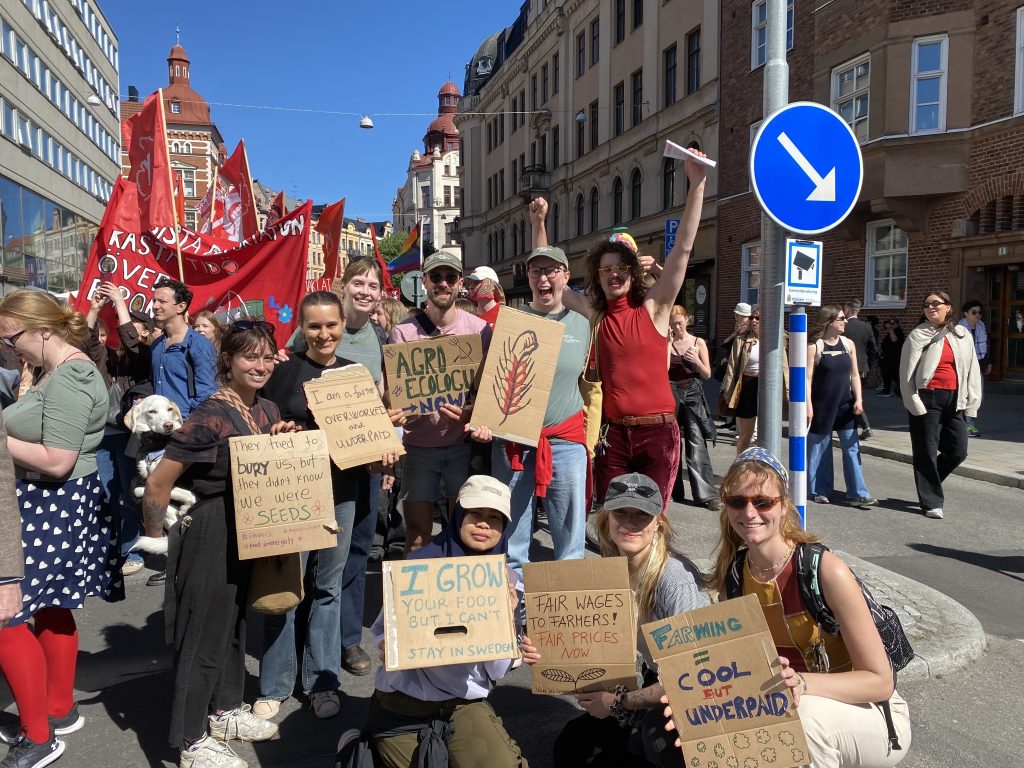
This year, we made a decision that would have felt unthinkable in any normal season: instead of working on the farm, during what is our busiest planting period, our whole team joined the International Workers Day Demonstration in Malmö. It felt more urgent to protest and speak up about our struggles than to put our crops into the ground.
Earlier this year, we were trying to hire five people so we can manage the sheer amount of work it takes to run the farm, including everything that comes with being an educational space committed to making agroecological knowledge accessible to our community and beyond. Even so, we can only afford to hire ourselves half-time, despite each of us putting in more than 40 hours a week. All of us earn far below minimum wage, since our income has to come from what we grow and sell. Some of our board members volunteer their time entirely, without pay.
The real reason we took to the streets
But the most outrageous, frustrating, and unjust reason we marched is this: because of Sweden’s new migration law, combined with our low wages, some of our core team members and fellow farmers are at risk of losing their visas, or of not having them renewed, and being forced to leave the country. As of publication, the minimum wage required for a non-EU citizen to obtain or renew a residency and work permit is 34,470 SEK per month before tax. This figure is tied to a national benchmark: 90% of Sweden’s median salary. For a farmer, and especially for a new entrant to the profession, meeting that bar is simply impossible. Over the past year, we have already lost several fellow farmers to this rule. I want to share three of their stories, though there have been more.
Javier
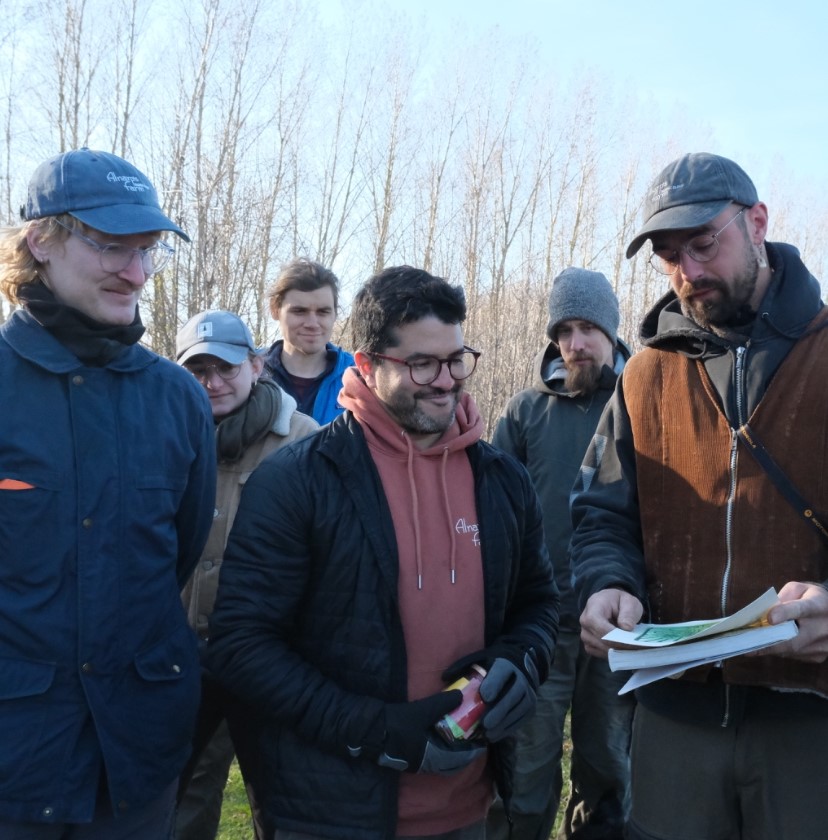
Just a few months ago, we had to say goodbye to Javier Morales, a long-time fellow farmer from Guatemala. He was threatened with deportation because he could not secure a position that paid enough, and we did not have the capacity to hire him either.
Mariana
The same threat now hangs over our chairperson, Mariana Forero, from Colombia. Despite working on the farm during the day and taking on a second job with night shifts to make ends meet, she is still at risk of losing her visa because her wage falls short of the legal minimum.
Eka
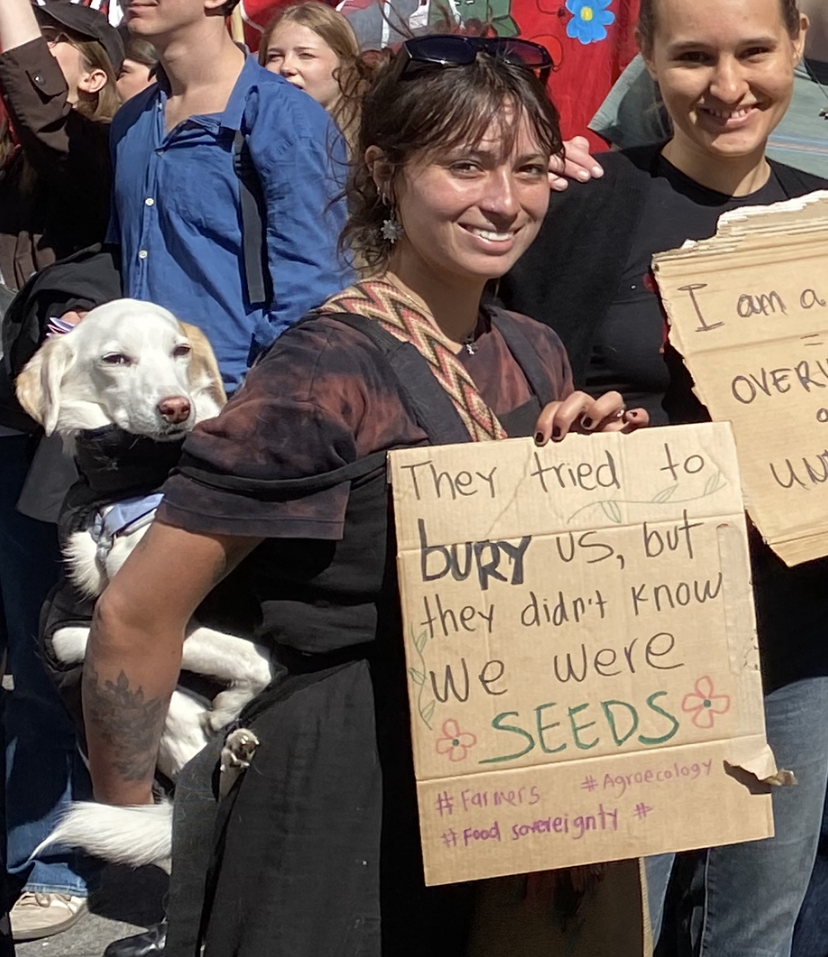
Our documentarian and fellow farmer, Eka Candra Wardani from Indonesia, cannot apply for a work visa either, even if we offered her a full-time position, because we would still not be able to pay her enough to meet the required threshold. As Eka wrote on her protest sign: “I grow your food, but I am not allowed to stay in Sweden.”
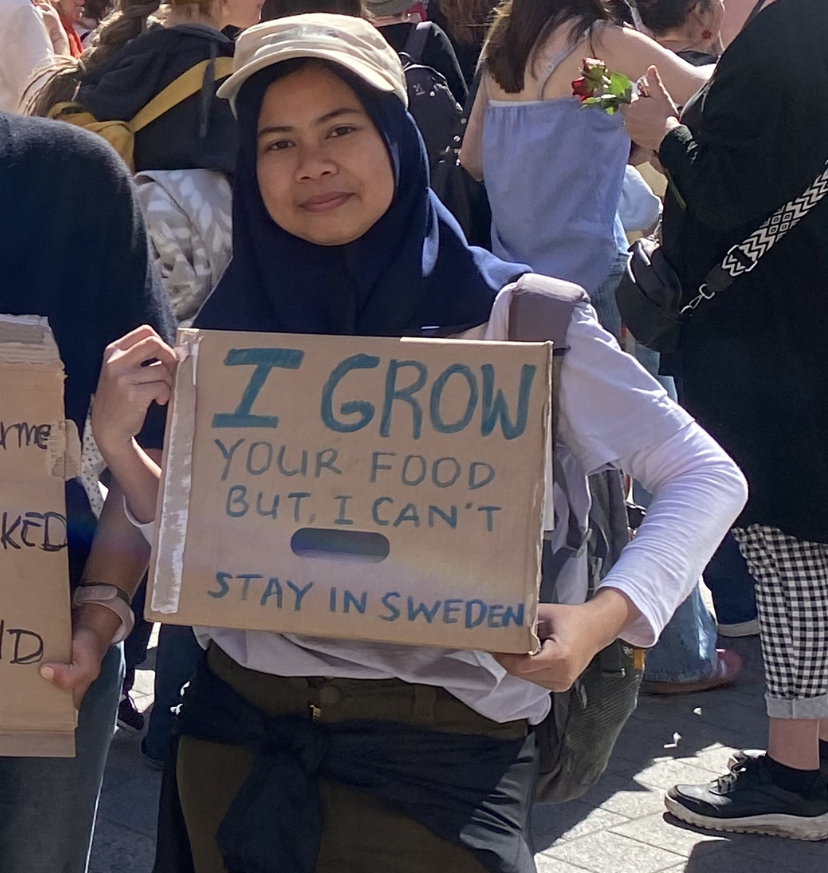
We are tired. We are sad. We feel helpless. We are devastated, and we are angry. Sweden and the EU are contradicting themselves in the most glaring way. I have sat in several high-level panels on Generational Renewal, listening to DG AGRI and Commissioner Hansen talk about the need to engage youth and motivate young people to enter the sector. The EU is set to lose half of its farmers within the next ten years due to retirement, and it is desperate to bring in youth, with a stated goal of attracting 375,000 new entrants in the coming years. And then I come back to our farm, and I watch the government put my friends, motivated, highly educated, engaged, young, and freshly trained farmers, onto planes, without even letting them get a foot in the door of farming here.
Commissioner Hansen referenced our farm at the New Year’s Reception of the Deutsche Bauernverband in January, earlier this year:
“Competitiveness without fairness is fragile. An agricultural sector that excludes talent, especially women, weakens itself. This is where Marie-Claire Feller’s story matters. Marie-Claire is a young woman farmer and agroecology practitioner in Sweden. Without inheriting land, she created Alnarp Agroecology Farm, a half-hectare living laboratory that feeds local families, produces applied research, and reconnects citizens with food production. Her story shows what happens when barriers are lowered, and access is enabled. It also reminds us of a simple truth: competitiveness is not gender neutral. The data are clear: women represent around 40% of the global agricultural workforce; even on farms of equal size, productivity gaps reach 24%; women still face barriers to finance, land, and leadership. This is not only unfair, it is economically inefficient.”
This particular line is the one that matters most to me: “Her story shows what happens when barriers are lowered, and access is enabled.” I would argue that the opposite is true. Mariana’s story, Eka’s story, and so many others show exactly what happens when barriers are set too high and access is denied: you lose skilled, motivated, young, female* farmers who were ready to become the next generation of farmers in the EU.
Why we are sharing this
I think these stories matter, because when you look at the actual profile of new entrants to farming, it is often people coming from other sectors entirely, frequently with academic backgrounds, some with university degrees in agricultural sciences. Many of them come from outside the EU, and they are structurally shut out from becoming new entrants, even when they are willing to go through everything it takes to become a farmer here.
Beyond being discriminatory and fundamentally unjust, these migration laws directly contradict DG Agri’s own stated goals: an agricultural sector that excludes talent, especially women, weakens itself. This is also, I want to stress, an intersectional issue: 2026 is the International Year of Women in Farming.
As a farm and as a community, watching what the people directly affected are going through, we feel isolated and helpless. Even if we cannot win this fight, sharing this story is a way to make sure that they, and we, don’t have to face it alone.
A wider pattern
What we are seeing at Alnarp is not unique. Across Europe, agroecological and small-scale farms depend heavily on migrant labour. Migrants make up an estimated one in four agricultural workers across the EU. At the same time, farming remains one of the lowest-paid sectors in Europe. Precarious income and precarious status, means the workers doing some of the most essential and physically demanding work in our food system are also the most exposed to losing the right to keep doing it. Alnarp isn’t an exception. It’s what happens when immigration policy continues to exploit migrants’ labour while stripping them of the rights and security that labour should guarantee.
*”Female” in this context is intended to include gender-queer people as well.